San Bruno Mountain, just south of San Francisco, is an example of the type of landscape that most needs environmental advocacy: a fragile ecosystem at risk from a proposed manufacturing facility. Green Foothills, a conservation nonprofit that has been a champion for nature on the Peninsula since 1962, is working alongside local environmental partners to halt this harmful development proposal and safeguard the mountain’s irreplaceable habitat.
San Bruno Mountain’s Landscape: A Haven for Biodiversity
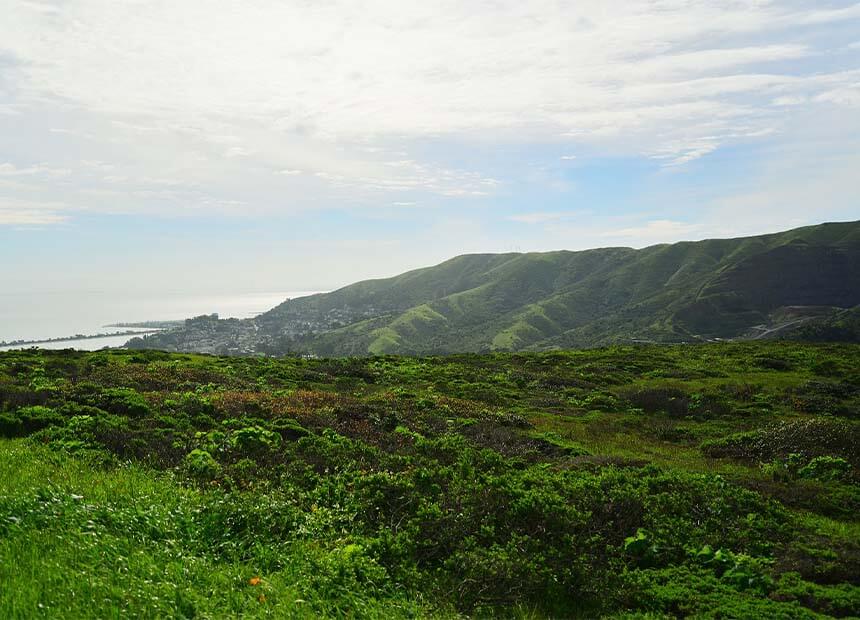
Rising above the cities of northern San Mateo County, San Bruno Mountain is a wild backyard for nearby communities and a living reminder of what the Peninsula once looked like. Across nearly 3,600 acres of grasslands, coastal scrub, woodlands, maritime chaparral, wetlands, and dunes, the mountain creates a patchwork of microclimates that support an astonishing variety of plants and animals, including 42 butterfly species. Three of the butterflies – the San Bruno Elfin, Mission Blue, and Callippe Silverspot – are federally endangered, and San Bruno Mountain is one of the last places where they can be found. The mountain is home to 14 rare plants, including endemic and endangered species, as well.
Development, pollution, and invasive species are constant threats. Native plants that are essential to the butterfly population, such as silver lupine, Pacific stonecrop, and the California golden violet, are threatened by invasive weeds that have established themselves on the mountain. Removing these invasive plants is directly tied to the survival of both the butterflies and their host plants. Local organizations and volunteers have worked tirelessly over the years to protect and restore native landscapes so these rare and endangered species can recover, and help is always needed. To get involved, you can sign up to help Green Foothills’ local partner, San Bruno Mountain Watch, at mountainwatch.org/upcomingevents.
Decades of persistent activism and conservation efforts have allowed the mountain to survive as a green dot in a sea of grey, an island of biodiversity that provides a haven for local wildlife. But the work is far from finished, as ongoing development pressures persist.
Advocacy to Save the Mountain: Past and Present
San Bruno Mountain’s open spaces did not survive by accident – their preservation was the result of decades of activism by neighbors who cared about the mountain. As surrounding baylands were filled and developed in the 1960s and 1970s, an urgency arose in the surrounding communities to conserve remaining open space. Early plans proposed leveling large swaths of San Bruno Mountain to provide more fill for the bay and to create subdivisions for future development. Residents strongly opposed these plans, circulating petitions that demanded conservation instead. After years of advocacy, the community was victorious. Development plans were halted, and in 1978 private landowners sold and donated acreage that became today’s San Bruno Mountain State and County Parks, protecting much, but not all, of the mountain. In the years since, development has continued to chip away at the mountain’s fragile habitat.
Today, a new threat has arisen to San Bruno Mountain’s endangered butterfly habitat. At the heart of San Bruno Mountain lies the Guadalupe Quarry, a mining operation that began in 1895 but is now mostly idle – and is looking to redevelop. In a proposal submitted to the City of Brisbane, developers initially proposed a 1.3 million square foot, Amazon-style warehouse. This environmentally harmful proposal prompted heavy pushback from local environmental organizations and community members. In response, the developers revised their plan, proposing instead to build an advanced manufacturing facility, possibly including a data center, and a substation. The developer claims this alternative will be smaller and more environmentally friendly, but the overall project footprint remains the same and still threatens unsustainable levels of environmental harm.
How the Recent Weakening of Environmental Regulations May Affect the Mountain
Up until a few months ago, advanced manufacturing facilities such as the one proposed on San Bruno Mountain would have been subject to the California Environmental Quality Act (CEQA), the state’s premier environmental law. CEQA requires analysis of the potential environmental impacts of development projects, including destruction of habitat for endangered species, and also gives the public an opportunity to comment on land use decisions in their communities. But earlier this year, in a rushed process that bypassed standard legislative practice, the California Legislature passed a controversial bill, SB 131. This bill creates a total exemption from CEQA for advanced manufacturing facilities – with no safeguards to protect threatened or endangered species habitat. The bill’s vague definition of advanced manufacturing raises serious concerns, as it could allow highly polluting industries that would severely impact sensitive environments to escape environmental review.
When SB 131 was passed, legislators committed to fixing the worst problems with the bill, including the CEQA exemption for advanced manufacturing facilities and the failure to protect threatened and endangered species habitat. A bill that would address these issues, AB 1083, was introduced late in the 2025 legislative session and is supported by more than 130 environmental groups, labor unions, and other nonprofits, including Green Foothills. But although AB 1083 may be approved in 2026, in the meantime polluting facilities may be able to avoid environmental review. The Guadalupe Quarry proposal on San Bruno Mountain is a potent reminder that harmful facilities, even when located on industrial sites, can still impact sensitive habitat.
How You Can Help
Green Foothills, together with San Bruno Mountain Watch, Mountain Butterfly Collective, and Sierra Club Loma Prieta Chapter, has been working to urge decision makers to reject harmful development proposals on San Bruno Mountain and instead prioritize ecological restoration. As the quarry’s operations wind down, the community faces a once‑in‑a‑generation choice: to turn this scarred landscape into a new industrial hub, or allow it to heal into a thriving habitat that could help secure the future of three endangered butterflies, especially the San Bruno Elfin, whose succulent host plant, Pacific stonecrop, is already thriving and regenerating in the upper terraces of the quarry. Green Foothills’ position is that no new industrial development is appropriate on San Bruno Mountain. This is a place to restore, not to sacrifice.
Protecting San Bruno Mountain will take sustained public pressure. You can help by signing the petition calling on local leaders to oppose any industrial development at the quarry site and instead support full ecological restoration. You can also subscribe to Green Foothills’ newsletter to stay updated, attend public meetings, and share this story with friends and neighbors. Every voice adds strength to the message that this mountain—and the species that depend on it—are worth fighting for.