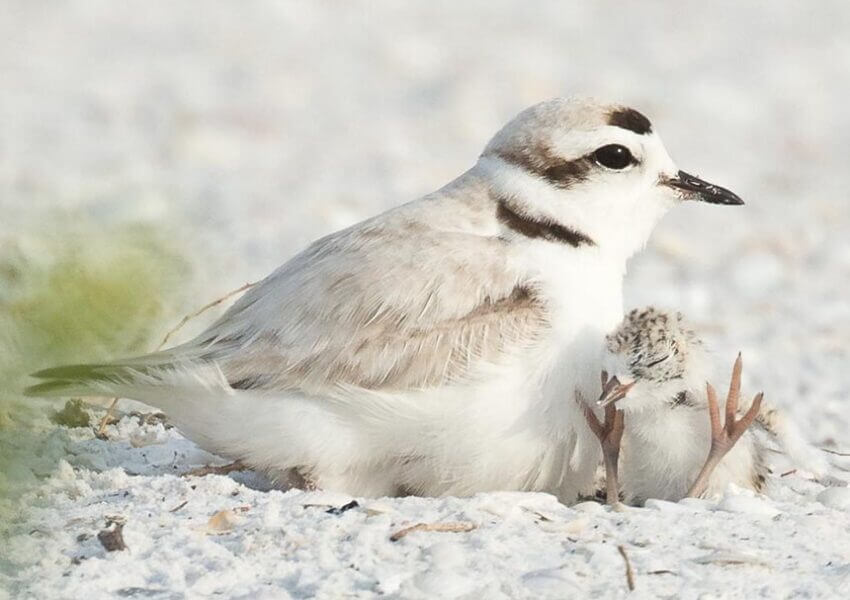
When you’re strolling along the beach or hiking bayside trails, you might catch a glimpse of a tiny bird on spindly legs running across the sand. With their quick movements and soft coloring, Western Snowy Plovers easily capture the hearts of those who are lucky enough to spot one. But these small shorebirds face outsized challenges. Listed as federally threatened in 1993, the Western Snowy Plover continues to struggle against habitat loss, disturbance from human activity, and off-leash dogs, all of which jeopardize these shorebirds’ ability to thrive on our shorelines. Several local organizations, including Green Foothills, are closely monitoring projects such as the SAFER Bay project to ensure that critical plover habitat is not impacted.
From Our Coastline to Our Shoreline
The Western Snowy Plover can be found on California beaches as well as the shorelines of the San Francisco Bay. They’re tiny birds, only about the size of a sparrow, with coloring on their bodies and eggs that helps them blend in with their surrounding environment. In fact, their nests can be so well camouflaged that they can go unnoticed even to the most well-trained eyes.
Plovers feed on a variety of invertebrates, from mole crabs to beetles, across diverse habitats – wet and dry sand, the edges of salt marshes, beached kelp, or salt pans. If visitors are lucky, they may even witness the birds darting through swarms of flies and catching them midair.
Today, the Snowy Plover is threatened by several external factors like increased predation, human activity, and habitat loss, which have contributed to declining population numbers. Natural predators such as crows, ravens, coyotes, and raccoons, as well as off-leash dogs and cats, can disturb and prey on adult plovers, their chicks, and their eggs. In addition, the birds’ spring and summer breeding season coincides with the busiest time on our beaches. This makes the plovers’ excellent ability to camouflage their nests an unexpected liability, as beachgoers may unintentionally disturb or even trample upon hidden plover nests.
To address these threats, government agencies and nonprofits have launched campaigns to “share our shoreline,” encouraging visitors to respect leash laws and posted habitat areas. Through these combined efforts, agencies hope to create an environment that allows both recreational users and the plovers to successfully coexist.
The Future of the Plover
Previously, federal listing under the Endangered Species Act (ESA) guaranteed certain protections for the birds and their habitat. However, revisions to the ESA recently proposed by the Trump administration have put this safeguard at risk. These changes would disregard climate change, eliminate habitat protections, remove blanket protections for threatened species, and redefine what constitutes “harm.” If passed, they could have devastating effects on currently listed and candidate species. Although the California Endangered Species Act (CESA) would soften the blow for species protected under both laws, the Western Snowy Plover is not listed under CESA and thus is in danger of losing all protections.
Despite this emerging threat, there is still hope for the Western Snowy Plover. Cities, state agencies, and local environmental organizations continue to collaborate on regional projects that could benefit the birds. The SAFER Bay project is one example where planners are incorporating habitat enhancement efforts such as creating larger nesting areas and spreading material that would help the birds hide from predators. These plans were made in hopes of offsetting any possible negative impacts that the project could have on critical plover habitat. As our shoreline and coastal communities continue to find ways to adapt to sea level rise, Green Foothills will continue to advocate for the protection of our beaches and baylands so that species like the Western Snowy Plover can thrive in our region.