

More than 6,600 homes have been proposed in rural Santa Clara County under the “builder’s remedy” law, putting thousands of acres of farmland and wildlife habitat at risk. Many of these proposed developments are also in areas prone to flooding and wildfires. The builder’s remedy was never intended to allow widespread sprawl development on open space and farmland, but that’s what’s happening. Green Foothills is working to protect wildlife, farmland, and people from the harmful impacts of these projects. You may have read some of our earlier articles on this topic. Here’s an update on what’s happening now.
What’s the Builder’s Remedy?
The builder’s remedy, sometimes called “SB 330,” is a provision in state law that severely limits cities’ and counties’ ability to reject certain housing projects, if those projects were submitted during a period when the city or county did not have a state-approved Housing Element (a plan for future housing growth).
There are very few circumstances in which a city or county may legally reject a builder’s remedy project. One such circumstance is if the project is proposed on land zoned for agriculture or resource preservation and is surrounded on at least two sides by other land being used for agriculture or resource preservation. Another is if the site does not have adequate water or wastewater facilities to serve the project. It’s not clear exactly what those terms mean, since they are not defined in the statute and this provision hasn’t yet been tested in the courts.
What’s Happening in Santa Clara County?
From 2023 to 2025, Santa Clara County did not have a state-approved plan for future housing growth. Sprawl developers took advantage of that time window to submit more than 40 builder’s remedy pre-applications to the County, nearly all of them on land zoned for agriculture or hillside preservation. Only 28 of those projects submitted full applications to the County by the deadline, but those 28 projects amount to over 6,600 residential units in total.
Some alarming statistics:
- Over 2,900 of those units are in FEMA flood zones.
- Over 1,100 are in wildfire hazard zones.
- Over 1,200 are in landslide hazard zones.
- Nearly 5,000 are on prime farmland soil.
- Over 1,100 are on hillside grassland or forests.
- Over 700 are adjacent to creeks or streams with important riparian habitat.
Importantly, none of these projects are on land that has water or sewer services available. This may mean that they are subject to being denied by the County based on the provision mentioned above regarding whether there are adequate water or wastewater facilities to serve the project. Also, most of the projects are on land zoned for agriculture or resource preservation, and some of those are surrounded on at least two sides by other such land, so they may be subject to being denied on that basis.
The County has created maps showing where all these builder’s remedy projects are located and the number of residential units in each one. These maps, plus more information about each project, can be found on the County’s builder’s remedy project page.
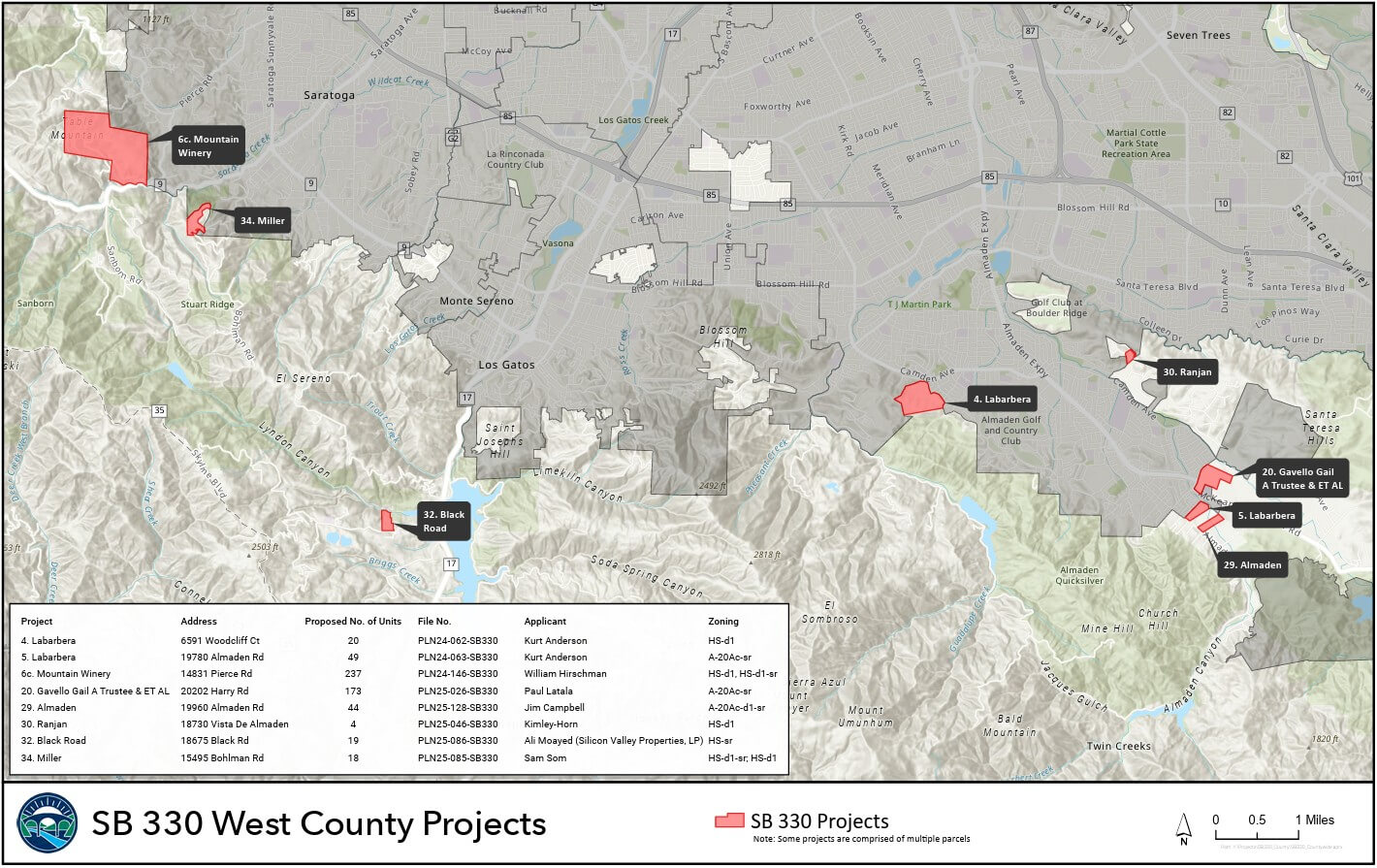
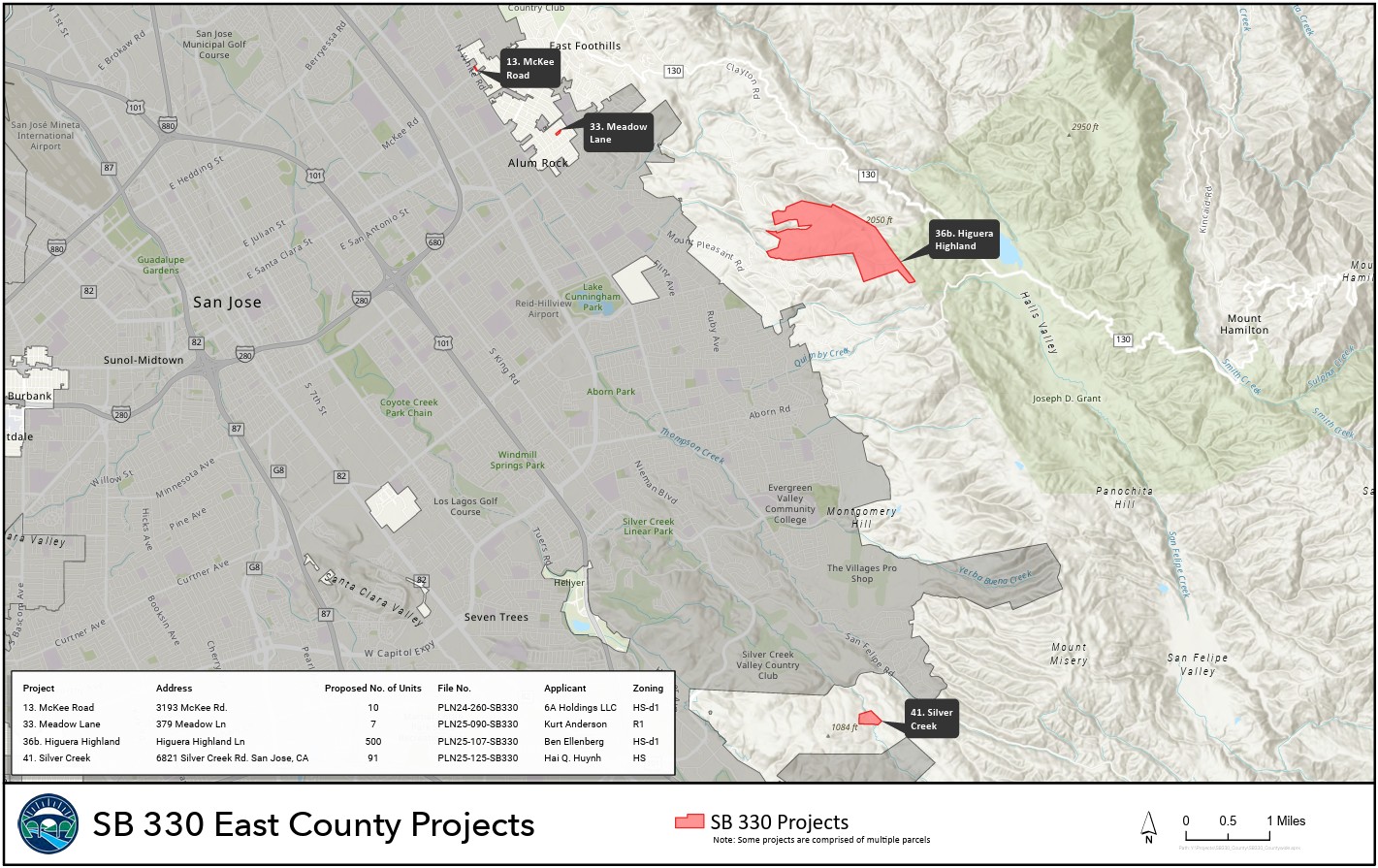
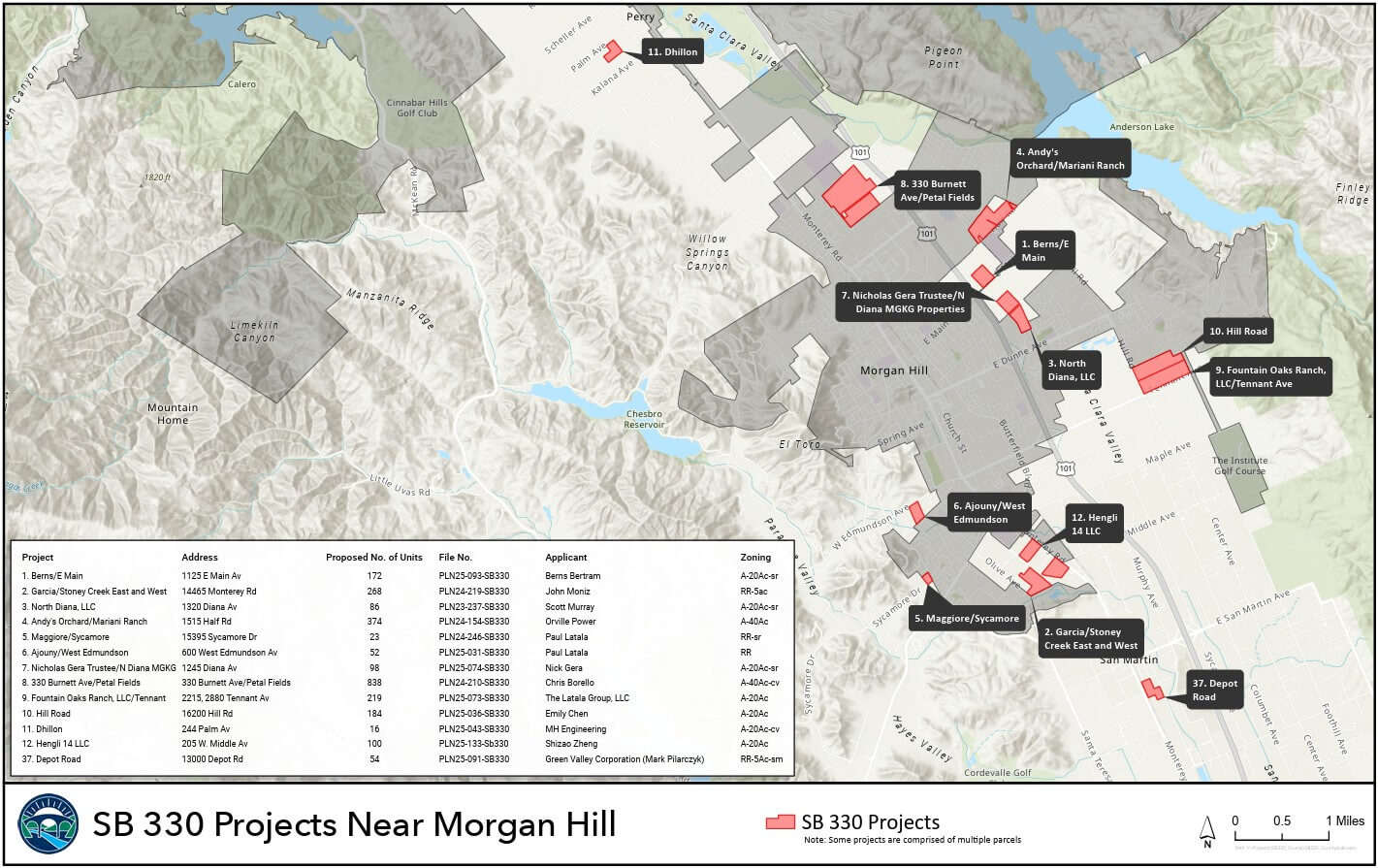
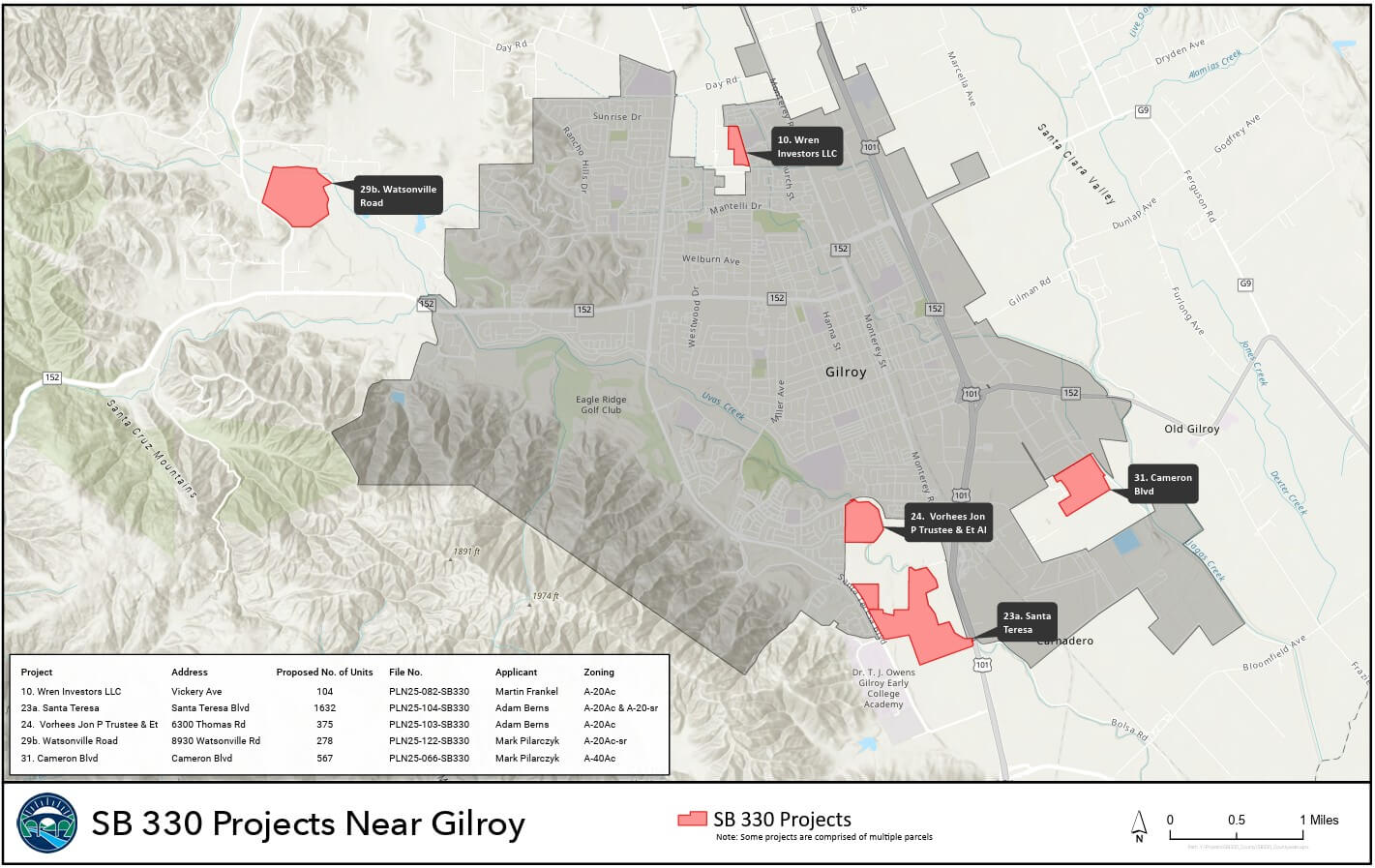
Some of the most egregious of these builder’s remedy projects include:
- “Bella Creek” at 8930 Watsonville Road east of Gilroy (29b on the above maps). This 273-home project would create an artificial lake in the Uvas Creek floodplain, fundamentally altering the hydrology and habitat of the creek. It would also destroy cultural sites held sacred by local Indigenous people including the Amah Mutsun Tribal Band. For more details, see this guest article from the Amah Mutsun Land Trust.
- “Silver Creek Valley Estates” at 6821 Silver Creek Road outside of San Jose (41 on the above maps). This 92-home project would destroy rare serpentine grassland, which provides habitat for threatened species including the Bay Checkerspot butterfly, and would also impact threatened California red-legged frogs in Silver Creek.
- “Encore Estates” at Mountain Winery, 14831 Pierce Road outside of Saratoga (6c on the above maps). This project for 237 homes plus an 81-room hotel is located in the middle of an oak woodland and critical wildlife corridor. The site is located on a steep hillside, in a very high fire hazard zone at the end of a long, narrow winding road with severe evacuation constraints.
- “Petal Fields” at 330 Burnett outside of Morgan Hill (8 on the above maps). This 838-home project would require a 3-mile-long new water pipeline through the middle of Coyote Valley, potentially impacting the Coyote Valley groundwater aquifer.
- “Black Road Estates” at 18675 Black Road outside of Los Gatos (32 on the above maps). This 19-home project is located on a forested hillside above Lexington Reservoir in the middle of a migration area for California newts. Bald eagles have nested here for many years, and cutting down the trees may cause them to abandon their nest.
- “Rancho Higuera” on Higuera Highland Lane outside of San Jose (36b on the above maps). This project for 553 homes plus an event center, riding arenas, and stables is located far up in the hills east of San Jose, on over 100 acres of hillside grassland habitat in a high fire hazard zone and landslide hazard zone.
- North Mesa Rd/Santa Teresa, Thomas Rd/Vorhees, and Cameron Blvd south of Gilroy (23a, 24, and 31 on the above maps). These projects cumulatively total 2,464 homes, all on prime farmland in a fertile agricultural plain. The three projects are in FEMA floodplains on the banks of Uvas and Llagas Creeks, where groundwater contamination and soil liquefaction are potential risks.
- 19780 Almaden Rd, Quicksilver Estates at 19960 Almaden Rd, Circle Hill Estates at 6591 Woodcliff Ct, and Gavello Glen at 20202 Harry Rd south of San Jose in Almaden Valley (4, 5, 20 and 29 on the above maps). These projects cumulatively total 279 homes, all in wildlife corridors connecting the open space area around Almaden Quicksilver County Park to Santa Teresa County Park and the Santa Cruz Mountains. These projects are either near creeks with high risk of soil liquefaction or on wooded hillsides in high fire hazard zones.
These are only some of the builder’s remedy projects currently on file with the County. Details about all of the builder’s remedy projects are on the County’s website.
What’s the Approval Process for Builder’s Remedy Projects?
These builder’s remedy projects are all subject to the California Environmental Quality Act (CEQA) and must undergo environmental review, which begins when the County releases a Notice of Preparation (NOP) announcing that the County will prepare an Environmental Impact Report (EIR) for the project. The public can submit comments responding to both the NOP and the EIR about how the project might impact the environment. Wildlife, groundwater, scenic views, air quality, and farmland are among the environmental issues that are analyzed as part of this process.
So far, the County has released NOPs for eight builder’s remedy projects, and more are expected soon. The County maintains a list of the projects that have NOPs thus far. If you want to be notified when the County releases the EIR for any of these projects, you can email the County planner listed under each project and ask to be put on the notification list. Once an EIR has been released, the public has a certain period of time (usually between 30-45 days) to comment. The County must review and respond to all comments received before a vote to approve the project happens. This can take as little as a few weeks or as long as several years, depending on the complexity of the project, the number and length of comments received, and other factors.
What Is Green Foothills Doing?
We are monitoring all 28 of these problematic builder’s remedy projects. We are submitting scoping comments on the NOPs and we will be commenting on the EIRs when they are released.
We are also working with other organizations on state-level policy efforts to ensure that this situation does not arise in the future. The builder’s remedy was never intended to result in massive sprawl on open space and farmland. The fact that these sprawl proposals have been submitted is a complete misuse of this statute.
Sprawl development not only harms wildlife habitat and farmland, it puts people in harm’s way. The builder’s remedy projects in Santa Clara County are a perfect example of the fact that sprawl development is frequently located in wildfire hazard zones, flood hazard areas, or sites vulnerable to seismic hazards or landslides. When disaster strikes, the developers who built these projects will not be the ones harmed.
Furthermore, sprawl development is costly for taxpayers and municipalities. It costs more to provide urban services such as police and fire protection, road maintenance, and even garbage pickup and utilities to sprawl development outside of cities. This is a primary reason why Santa Clara County has for decades mandated that new development should take place within cities, not in the rural areas.
Green Foothills will continue working to ensure that new homes are built in cities, not on open space or farmland where future residents would be exposed to hazardous conditions. If you want to be notified when an opportunity arises to speak out about these builder’s remedy projects, please sign up to receive our emails.