In 1976, California drew a line in the sand when it passed the California Coastal Act, protecting the coast and establishing safeguards to balance development with conservation. Green Foothills was one of the driving forces behind passing the Act, and we’ve continued working to protect the coast ever since. Today, we celebrate five decades of progress – remembering that, as Coastal Commission Executive Director Peter Douglas said, “The coast is never saved; it is always being saved.”
The Coastal Act was a watershed moment. It established the processes and legal protections needed to balance development with conservation, ensuring that decisions about the coast would be guided by the public interest rather than short-term pressures. As a result of the Coastal Act, thousands of new public access points now connect people to the coast, and more than 4,600 acres of coastal habitat have been restored. There have been disagreements and setbacks along the way, but the Coastal Act has endured because public support for it remains strong.
How We Came Together to Save the Coast
The movement to protect the coast began well before the Coastal Act became law.
In the 1960s, Bay Area elected officials, developers, and governmental agencies envisioned a very different coastline with multi-lane freeways crossing from the Bayside over Skyline Boulevard and along the coast from San Francisco all the way down to San Luis Obispo, as well as a dam and massive reservoir to be built at Worley Flat on Pescadero Creek. Ancient old-growth redwoods would have been cut down to make way for the reservoir, which would have provided water for 100,000 people to live on the southern San Mateo County coast.
Alarmed by this onslaught of environmentally damaging sprawl proposals, Green Foothills sprang into action. We wrote letters, spoke up at hundreds of public meetings and hearings, and enlisted the support of other like-minded citizens and organizations. But we knew these threats would continue unless measures were taken to protect the coast.
Across California, people had similar fears about unchecked development and the loss of public access to the coast. This led to a groundswell of support for legal protection of the entire coastline. In 1972, California voters passed Proposition 20, the Coastal Zone Conservation Act, which created an interim “Coastal Zone Commission” to halt unchecked development on the coast until the State Legislature was able to draft and pass a Coastal Act. Green Foothills campaigned for Proposition 20, and we were thrilled when it passed.
How the Coastal Act Protects Our Shorelines
Proposition 20 eventually led to the passage of the California Coastal Act in 1976. The Coastal Act is a comprehensive land-use planning document that requires each city and county along the state’s 1,100 miles of coastline to prepare a Local Coastal Program (LCP) and to issue permits for certain categories of new development. The California Coastal Commission, a 12-member agency appointed by the Governor and State Legislature, ensures that federal, state, and local governments fully adhere to the Coastal Act.
The Commission also considers appeals of locally approved projects that don’t comply with LCP resource protection policies, and projects that do not adequately provide for maximum public access to and along the shore.
Defending the Spirit of the Coastal Act on the San Mateo County Coast
In 1980, Green Foothills succeeded in convincing the San Mateo County Board of Supervisors to adopt a strong LCP – the first county LCP to be certified by the Coastal Commission.
However, just six years later, a new pro-development majority on the Board of Supervisors set to work amending San Mateo County’s LCP to weaken many of its strongest protections. But once again, the love of ordinary citizens for the coast proved to be stronger than developers’ plans to exploit it. In 1986, Green Foothills campaigned for Measure A, the San Mateo County Coastal Protection Initiative, which passed by an overwhelming 63%. Measure A ensured that 37 key policies protecting the rural San Mateo County coast cannot be weakened or discarded without a countywide vote.
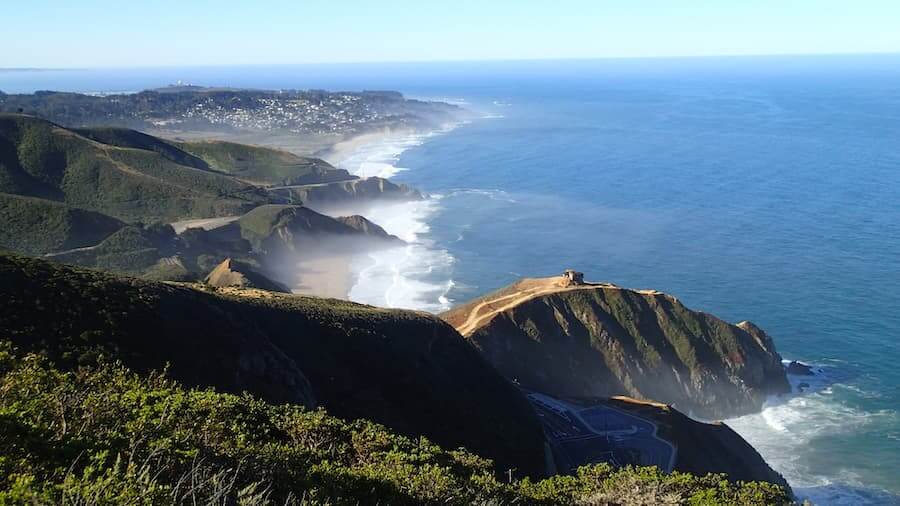
A decade later, Green Foothills was instrumental in passing San Mateo County’s Measure T, the Devil’s Slide Tunnel Initiative. Approved by 74% of voters, Measure T required Caltrans to build a tunnel at Devil’s Slide instead of a proposed seven-mile freeway bypass that would have devastated McNee Ranch State Park. The tunnel opened in 2013, and the former highway became a scenic multi-use trail enjoyed by thousands of visitors today.
Green Foothills also helped create and expand the Midpeninsula Regional Open Space District (Midpen) to include the coast. Midpen has permanently protected vast stretches of coastal grazing land, sensitive habitats, and open space. The nonprofit Peninsula Open Space Trust has also acquired key coastal properties, including productive farmland. Public access to county beaches has been guaranteed, and many new coastal access trails and overlooks have been opened to the public. Notable examples are Cowell State Beach; Whaler’s Cove at Pigeon Point State Park; Pillar Point Bluff, an addition to the Fitzgerald Marine Reserve; and most recently Tunitas Creek Beach, which opened in August 2026.
The Coast Is Always Being Saved
Today, Green Foothills continues to champion protection of the coast. We are watching two proposals for inappropriate development on rural, agricultural, and open space lands in coastal San Mateo County: Stonewood Lodge, a sprawling resort proposed for the rural Midcoast area, and a harmful “builder’s remedy” project at Shamrock Ranch near Pacifica, on land the City says it cannot serve with municipal water and sewer services. We are advocating for these two properties to remain in open space and agricultural uses.
The Coastal Act has withstood many attempts to weaken it over the decades, and those attempts continue today. Green Foothills, together with coastal advocates up and down the state, will continue to work to ensure that California’s 50-year legacy of protecting and honoring our precious coastal region lives on for future generations.
Share Your Favorite Photos of the Coast
In celebration of the Coastal Act’s 50th year, we’re collecting favorite photos of the San Mateo County coast. Would you like to share your best photos of the coast with Green Foothills to help us publicize our coastal advocacy efforts? Email your photos to Jenny Green, Green Foothills’ Marketing Director, at jenny@greenfoothills.org. Photos submitted must be your original work and free from any third-party copyright restrictions. Please specify the location where you took the photo and include your name so we can acknowledge you when we publish the photo. We’ll share the photos in our October 28 email newsletter.
An earlier version of this article was published in Green Foothills’ summer 2026 newsletter.